Hallo... which TV show gives you nightmares? A horror series or a violent series? How about an animal series? Did you say - a show about animals? Oh yes I did!
Recently, the Animal Planet TV channel ran several back to back episodes of a reality series called, Animal Precinct. This show takes you on patrol with New York City's Humane Law Enforcement agents who are devoted to investigating crimes against the city's animal population. The series starts off something like this… “New York City, 8 million people, 5 million pets, 1 team of officers…”
Of course yours truly read the disclaimer – “Due to the graphic nature of this program, viewer discretion is advised…” but for some reason it did not register in my brain that a show about pets is one that I should be advised against.
So, there I was watching a string of shows that resulted in a string of nightmares. Major impact on my sleep system and one that caused shifts in my mind set!
Okay, you get the picture, but let me explain why this show causes nightmares. Not because it is a bad show, it is an excellent show, but the horrors it exposes one to would make Buddha commit suicide.
Just one show later, I was left with a zillion questions buzzing in my head like: why do people get pets if they can’t look after them? More so, why do people get pets they end up mistreating? And the purpose of a pet is what? I would think companionship, and it involves caring, loving, and spending time with.
Just like the USA has a very tough application and approval process for people who want to adopt a child, I call for a similar system for those who want to bring a pet into their lives. The goal is to make people think twice before they consider something they might not be able to handle. All in favor say, AYE!
-zensufi-
June 5, 2006


May 8, 2006
Case Study: A Foster Child
Modified Paper from 2003 - "Case Study of A Foster Child’s Grief and Loss"
A non-profit organization in Minnesota known as, Resources for Adoptive Parents held monthly respite camps for adopted and foster children. Families dropped off their children for the entire weekend and adoption counselors engaged the children in a wide variety of activities. Most of the activities revolved around adoption issues, creating awareness, understanding, generating peer support, and making it a fun experience for the children. A key outcome was, that the children connected with others realizing that they were in the same situation as themselves. Thoughts and emotions were shared on a one-on-one basis and during group sessions.
One weekend, an adoption counselor and myself, held a group session in which we asked the children to share one good thing and one bad thing about adoption or foster care. A seven year old, Joey, waved his hand wildly asking to be called upon. Sensing his enthusiasm, my colleague asked him to share his thoughts. Joey proudly boasted, that the good thing about foster care was that he had been in fourteen homes in two years. The bad thing about foster care was, that he had not seen his mother in a long while.
After hearing Joey’s viewpoint, the other children shouted out the number of homes they had been in through their lives and within seconds the group became disorderly. Some stated, that they went through several homes before they were finally adopted, while others were still in search of a permanent home. What started out as an excited self disclosure turned into a competitive game, and the group had to be calmed down so we could continue. Ultimately, the children discussed their loss or losses, and expressed that being in many homes was not fun after all. They wanted permanency, security, and to leave behind the grief experienced with each departure.
In the case of foster children like Joey, they do not really consider being in several homes a plus point nor a competitive game. Joey wanted to make a statement and express his feelings, which did not appear to come from a sense of loss, but they did. When we dug deeper during a few one-on-one sessions with Joey, it explored the loss experienced by him when he left each foster home. His grieving was continuous and he was not given a chance to complete his grieving process and move on, because he kept moving on to another home. Each time he is abandoned by a set of foster parents, he keeps tally and knows exactly how many homes he has been in and out of in how long. It almost appears as if, Joey accepts this abandonment and loss process as a normal event in life which will continue and he will keep counting.
When we approach Joey’s story from another angle, it is rather strange that he went through so many homes in two years. Usually in the State of Minnesota, foster parents keep a child for six months or less. Perhaps, it indicates that Joey disrupted the homes he was sent to, and therefore, was removed from each home after a short period of time. When a child has experienced a certain way of life to be normal, however dysfunctional per the standards set by society, the child will see the dyfunctionality as normal. Children in foster care are abandoned by their biological parents, each set of foster parents they live with, social workers when they are changed, educators, classmates, and many others. A foster child like Joey has not even been allowed to go through the entire grieving process. For him, loss is added to more loss and the grief continues, until he is permanently placed or turns eighteen years old, at which point he will be allowed to exit the foster care system.
Thousands of Joeys’ lives have been tabulated into numerous volumes of statistical data. The material has been researched, analyzed, compiled, and presented to the nation decade after decade. Knock on the door of the U.S. Department of Health and Human Services or any other organization that focuses on child adoption or foster care research, and you will gain access to amazing statistical details regarding the race, gender, age, and even psychological profile of foster children, birth families, adoptive families, and much more. Despite all the facts, children still continue to enter, leave, and remain in the same system, but more so, for now, these children need to be allowed to grieve.
-zensufi-
A non-profit organization in Minnesota known as, Resources for Adoptive Parents held monthly respite camps for adopted and foster children. Families dropped off their children for the entire weekend and adoption counselors engaged the children in a wide variety of activities. Most of the activities revolved around adoption issues, creating awareness, understanding, generating peer support, and making it a fun experience for the children. A key outcome was, that the children connected with others realizing that they were in the same situation as themselves. Thoughts and emotions were shared on a one-on-one basis and during group sessions.
One weekend, an adoption counselor and myself, held a group session in which we asked the children to share one good thing and one bad thing about adoption or foster care. A seven year old, Joey, waved his hand wildly asking to be called upon. Sensing his enthusiasm, my colleague asked him to share his thoughts. Joey proudly boasted, that the good thing about foster care was that he had been in fourteen homes in two years. The bad thing about foster care was, that he had not seen his mother in a long while.
After hearing Joey’s viewpoint, the other children shouted out the number of homes they had been in through their lives and within seconds the group became disorderly. Some stated, that they went through several homes before they were finally adopted, while others were still in search of a permanent home. What started out as an excited self disclosure turned into a competitive game, and the group had to be calmed down so we could continue. Ultimately, the children discussed their loss or losses, and expressed that being in many homes was not fun after all. They wanted permanency, security, and to leave behind the grief experienced with each departure.
In the case of foster children like Joey, they do not really consider being in several homes a plus point nor a competitive game. Joey wanted to make a statement and express his feelings, which did not appear to come from a sense of loss, but they did. When we dug deeper during a few one-on-one sessions with Joey, it explored the loss experienced by him when he left each foster home. His grieving was continuous and he was not given a chance to complete his grieving process and move on, because he kept moving on to another home. Each time he is abandoned by a set of foster parents, he keeps tally and knows exactly how many homes he has been in and out of in how long. It almost appears as if, Joey accepts this abandonment and loss process as a normal event in life which will continue and he will keep counting.
When we approach Joey’s story from another angle, it is rather strange that he went through so many homes in two years. Usually in the State of Minnesota, foster parents keep a child for six months or less. Perhaps, it indicates that Joey disrupted the homes he was sent to, and therefore, was removed from each home after a short period of time. When a child has experienced a certain way of life to be normal, however dysfunctional per the standards set by society, the child will see the dyfunctionality as normal. Children in foster care are abandoned by their biological parents, each set of foster parents they live with, social workers when they are changed, educators, classmates, and many others. A foster child like Joey has not even been allowed to go through the entire grieving process. For him, loss is added to more loss and the grief continues, until he is permanently placed or turns eighteen years old, at which point he will be allowed to exit the foster care system.
Thousands of Joeys’ lives have been tabulated into numerous volumes of statistical data. The material has been researched, analyzed, compiled, and presented to the nation decade after decade. Knock on the door of the U.S. Department of Health and Human Services or any other organization that focuses on child adoption or foster care research, and you will gain access to amazing statistical details regarding the race, gender, age, and even psychological profile of foster children, birth families, adoptive families, and much more. Despite all the facts, children still continue to enter, leave, and remain in the same system, but more so, for now, these children need to be allowed to grieve.
-zensufi-
April 16, 2006
The Holistic Foster Child

Modified Paper from 2003 - "Holistic Approach for Handling a Foster Child’s Grief and Loss"
Grief and loss with respect to the foster child have not been dealt with effectively in the USA, and I believe a holistic approach has been proven to be the most effective way of dealing with grief and loss in foster families. There is a need to take an insightful and personalized approach in dealing with complex issues, for the foster child goes through a traumatic time being shifted from one home to another. The basic rationale for addressing grief and loss as experienced by the foster child, stems from the lack of family education and awareness of the issues surrounding the foster child’s grief and loss. In particular, grief education and foster care training for foster families would provide tools to aide in a smooth transition for the entire foster family.
With over 550,000 children in the foster care system, the nation is failing to get them out of the system and adopted into homes. The very system that was created to protect neglected and abused children, has wrapped itself up in so much bureaucracy, that it has created a parallel and inescapable cycle of abuse. Unfortunately, most foster children spend months and even years, being shuffled in and out of various temporary homes. Each year, only a fraction of children are legally adopted, while the rest are thrown back into the recycle bin of the foster care program. The net result is, we have thousands of children experiencing loss and grieving with each change of residence. In the life of a foster child, change is constant. This change presents uncertainty. When taken from one home to another, the child walks into the unknown carrying with him or her, fears and insecurity.
Most, if not all children in foster care experience a tremendous sense of loss. There is a loss of their familiar home surroundings, at least some disruption of daily routines, loss of personal belongings, and family members. How a child experiences loss depends on many factors including: the child's developmental level, the significance of the people separated, whether the separation is temporary or permanent, and the degree of familiarity of the new surroundings. Foster children are often in an indeterminate state. When initially placed into care, it is often unknown whether the child will or will not return home. Until a biological parent's rights are relinquished or terminated, it is difficult for a child to complete the grief process. If the child goes on to be placed in other foster homes, he or she may never complete the grief process until they are out of the foster care system.
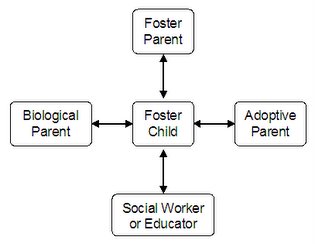
A holistic approach for handling a foster child’s grief and loss can be broken down into four sections, based on factors that influence a foster child’s life: the foster parent, the biological parent, the social worker or educator, and the adoptive parent if there is one. All four factors impact a foster child’s life and shape it in the process. Offering grief education and foster care training to all parties involved in a foster child’s life, would arm them with tools to aide in a smooth transition. Grief education can include classes or seminars covering the psychological impact of grief on a child, with a particular focus on the foster child. The format can be a mixture of two styles; lecture and interactive. Attendees will learn and use what they have learned at the same session, which opens up the course for further feedback.
Support groups for foster parents are a great opportunity to discuss and network with others whose lives have been impacted by a foster child and the foster care system. Working together the parents can gain a better understanding of the foster child’s emotional vulnerabilities and share what methods worked best for them when dealing with grief issues. On a one-on-one level, the foster parent can help the child feel safe, secure, and better prepared for their next placement. Through honest and direct communication, the foster parent can facilitate and assist the child’s natural grieving process by discussing foster care issues and educating themselves and their foster child. In addition, foster parents and social workers need to work closely to develop a plan to help the child grieve and adapt during the transitional time between permanent homes.
Educators spend a lot of time with their students and in many cases, are not aware of those in the class who are foster children. A teacher might unintentionally refer to biological or foster parents in a way that brings a foster child’s grief to the surface, causing them to modify their behavior. Also, a teacher might not be equipped to discuss the foster care situation with any degree of sensitivity. If a foster parent meets with the teacher and informs him or her before the child starts class, it would make the child’s classroom experience more favorable for all. It is best to teach the child to take the energy from their grief and trauma and focus it on something positive, like school interactions and building friendships. Brief one-on-one occasional meetings between a foster parent and teacher are ideal, because foster children tend to need more attention.
The social worker should work with the foster parent and assist the child to deal with his or her feelings. The child may not want to put feelings into words, so using play, drawing pictures, creating clay models, and other artistic methods of exploring feelings can be used. If the child wishes to verbalize their thoughts, then active listening can be an effective tool for validating emotions. Also, at this point the child’s biological parents and the loss experienced by being separated from them can be addressed. Most foster children feel abandoned by their biological parents and deeply grief the loss of the parents with grew up with however dysfunctional the family.
Involving the future adoptive parent in the life of the foster child before the placement takes place, aides in a better transition. Between finding a permanent home for a foster child and all the lengthy legal paperwork involved, there could be a long waiting period. If prospective adoptive parents attend adoptive or foster parent support groups, it could prepare them for what is to follow. Ideally, with the foster and adoptive parents working together openly in front of the child, it makes the child feel less of a sense of loss when they move into a permanent home.
Addressing grief and loss in foster care and creating awareness aides in the prevention of more complicated psychological issues for the entire foster family. Through the assistance and support of their foster parents, biological parents, social workers, educators, and adoptive parents – all working collectively, a foster child can come to terms with their being in the foster care system and work through their grief and deal with their loss. The key is for individuals to help individuals build a better family through education and awareness.
-zensufi-
Subscribe to:
Posts (Atom)


